2.2.1.1. Introduction
To schematize, robot control requires:
1 Robot sensors to measure the state of the robot, including potentiometers, encoders, limit switches…
2 Digital serialization of analog signals provided by the sensors using ADC, encoder chips…
3 Converting the digital signals from the serialization to data usable by the control algorithm, integers or floating point numbers (for example PID)
4 Computing a command to be sent to the actuators based on the current state
5 Converting the command from integers or floating point numbers to bits based on the amplifiers used
6 Converting to motor commands using linear amplifiers or PWM chips (current, voltage, duty cycle…)
7 Actuators to make the robot move
The design of the dVRK is based on centralized computing (4) on a PC and distributed I/O on the controllers (2, 3, 5 and 6 over FireWire or Ethernet).
The controllers themselves use two distinct components, a logic board (also known as FPGA or FPGA1394) for 3 and 5 and a board for signal processing and motor/brake power for: QLA for da Vinci Classic (for 2 and 6) and dRAC for da Vinci Si (for 6). The custom electronic components (FPGA, QLA and dRAC) are all designed by the Johns Hopkins group under the direction of Dr. Peter Kazanzides. The board designs, bills of materials, and all the firmware source is freely available on GitHub (see links in reference section).
Different boards are used on different configuration and generations of dVRK controllers. Some boards are specific to each da Vinci version and are described in later sections: dMIB, dSIB, DQLA, dSIB-Si, dSIB-Si, dSIB-Z-Si. These boards are mostly adapters between different types of existing connectors.
For the dVRK-Si, most of the signal processing (encoders, potentiometers…) is performed on original boards embedded in the da Vinci arms (2). Instead of designing and manufacturing custom boards, we are able to re-use the existing boards (ESPM and ESSJ) but with a custom firmware.
In the figure below, you can see the overall design for the dVRK Classic and Si controllers for both the active arms (PSM, ECM and MTM) and SUJs.
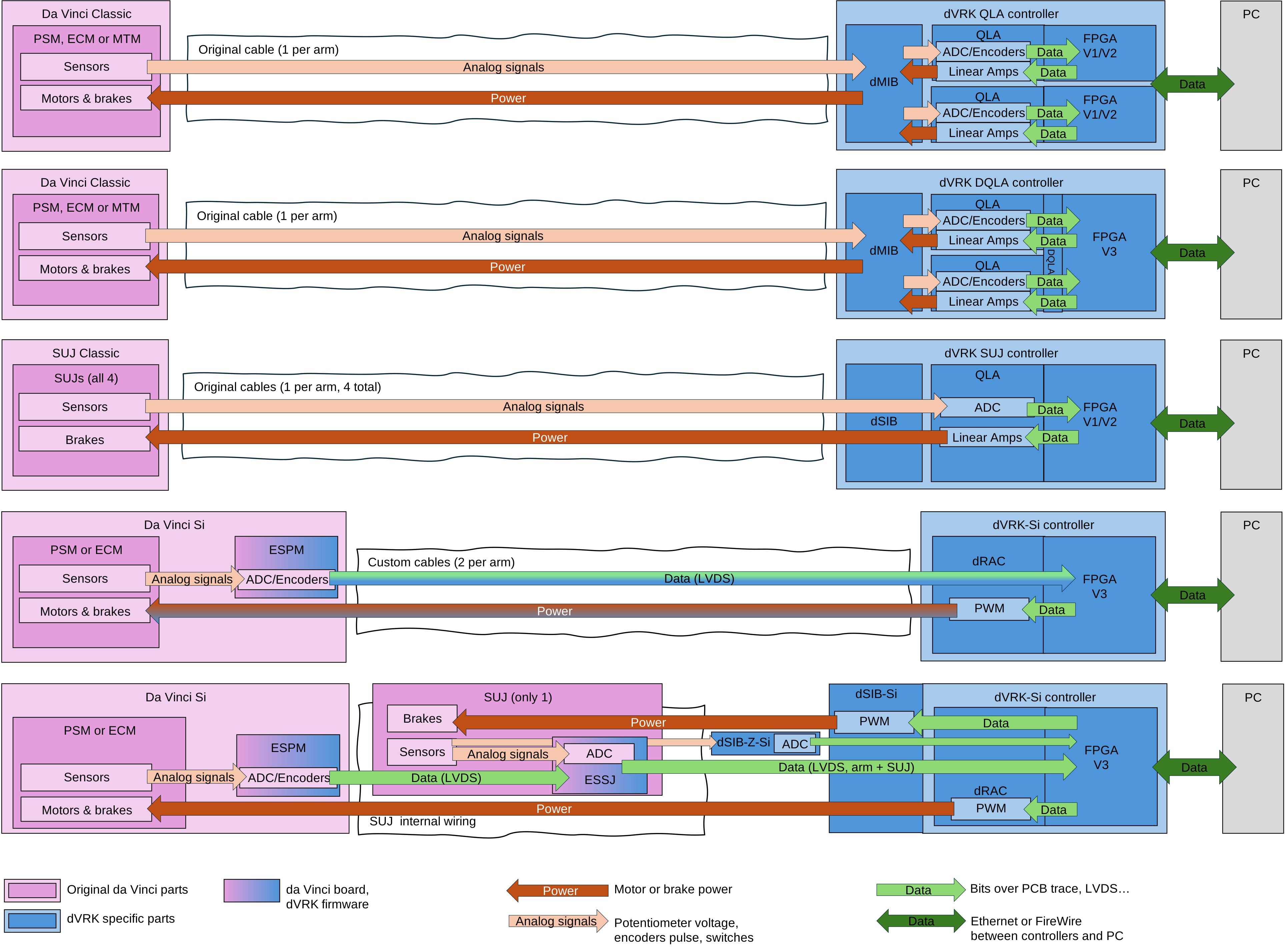
Overall view of dVRK controllers integration
All acronyms are defined in the reference section. The following sections provide an overview of the main dVRK custom boards: FPGA, QLA and dRAC.