5.2.2.2. Threads
In general, each component owns a thread and can run at its own frequency. There are a few notable exceptions:
There is a single IO component with multiple interfaces (one per arm connected). This is required to:
Minimize the number of IOs (inputs/outputs). For n boards (2 per arm controllers in most cases), sequential reads and writes would require 2 x n IOs, one read and one write per board. FireWire also allows to broadcast a single write command to multiple controllers and read from all controllers in a single message. This reduces the number of IOs to a fixed number (~2), whatever the number of controllers are used. This is only possible if a single thread manages all the IOs.
Avoid simultaneous accesses to the FireWire port from multiple threads (FireWire read/write are thread safe, but processes can hang for a couple seconds).
The PID components could run in separate threads, but this would introduce a fair amount of latency since the thread safe communication mechanisms in cisstMultiTask are based on queues. Assuming a 1-millisecond period for both IO and PID, the PID would read some cached data (position and velocity) from the IO (between 0+ and 1 millisecond old) and then request a new effort. This request being queued will be acted on between 0+ and 1 millisecond later. Overall, the time between read and write could be as high as 2 milliseconds. Instead, we used the cisstMultiTask ExecIn/ExecOut feature (see cisstMultiTask concepts) which allows to attach a component to another. Effectively, the parent thread now runs the child’s computation whenever needed. In pseudo code:
IO::Run(void) {
  ReadAllData();
  SaveReadDataInStateTable(); // state tables are used to cache data
  ExecOut(); // trigger PID.Run() for all PID components attached to this IO
  ProcessQueuedCommands(); // dequeue all commands, including those from PID
}
Qt manages its own thread(s)
The ROS bridges (cisst-ros) also use multiple threads
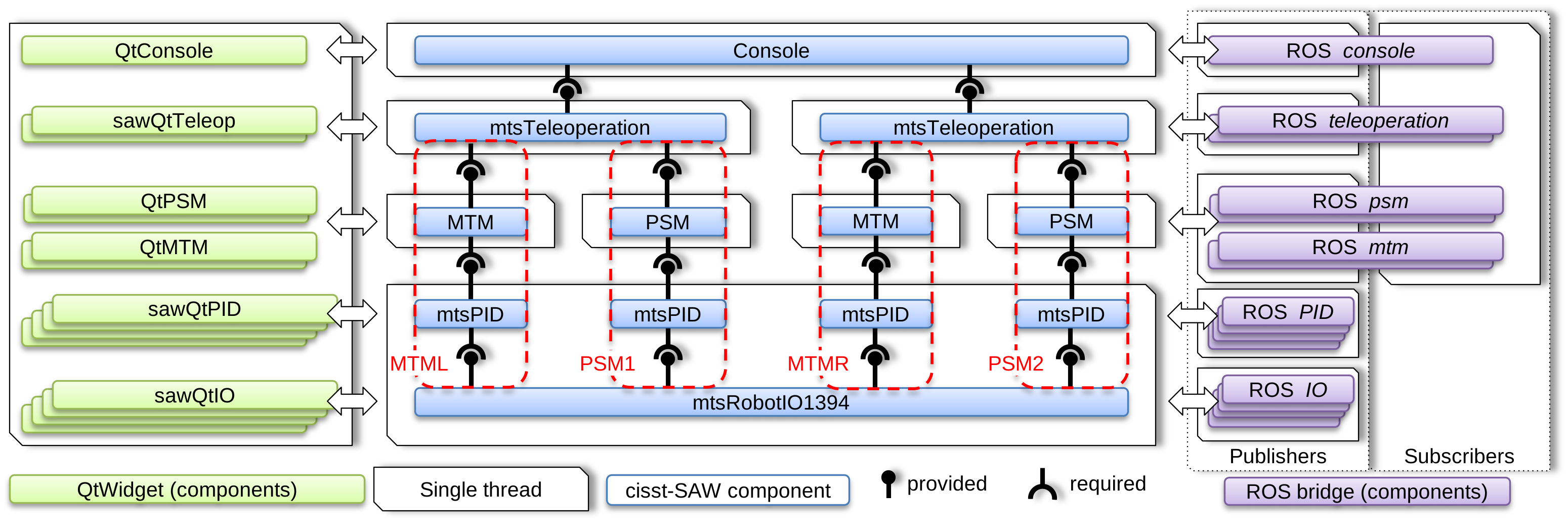
Main components and threads for the dVRK software stack