2.1.1.1. Introduction
History
The first generation da Vinci, IS1000 and IS1200 (also known as Standard or Classic) was developed in the late 1990s. It was retired from clinical use in 2012.
Note
Intuitive uses the name “Standard” for the first generation by contrast to the second generation da Vinci which came with a high definition video pipeline (standard definition vs. high definition). We found “Standard” a bit confusing, so we tend to call the first generation system “Classic”.
Note
The da Vinci S (second generation) used a surgeon’s console very similar to the Classic systems. For the dVRK community, MTMs from a da Vinci S are still called MTM Classic. The same applies to the head sensor, foot pedals…
Main components
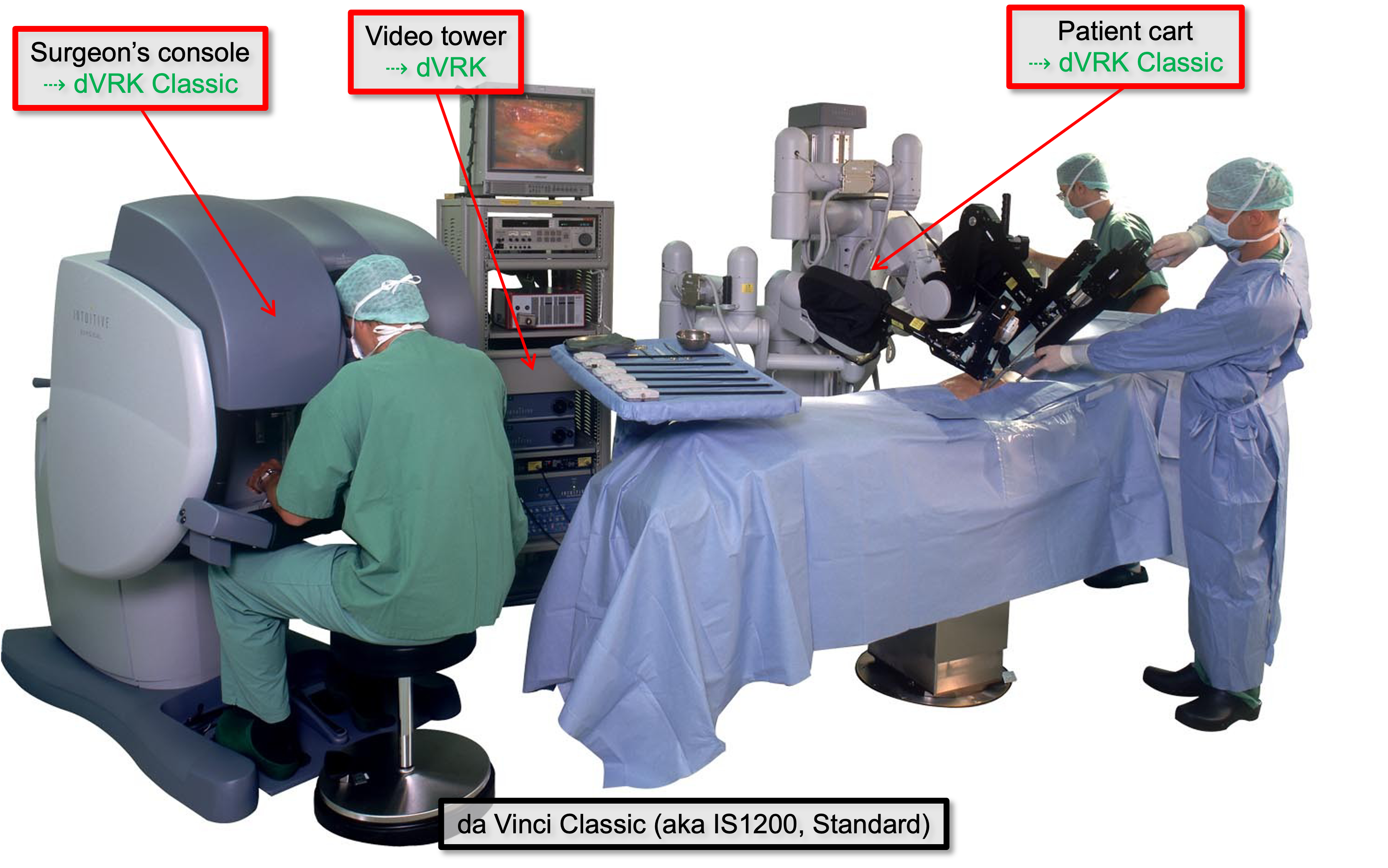
da Vinci Classic: surgeon’s console, video tower and patient’s cart
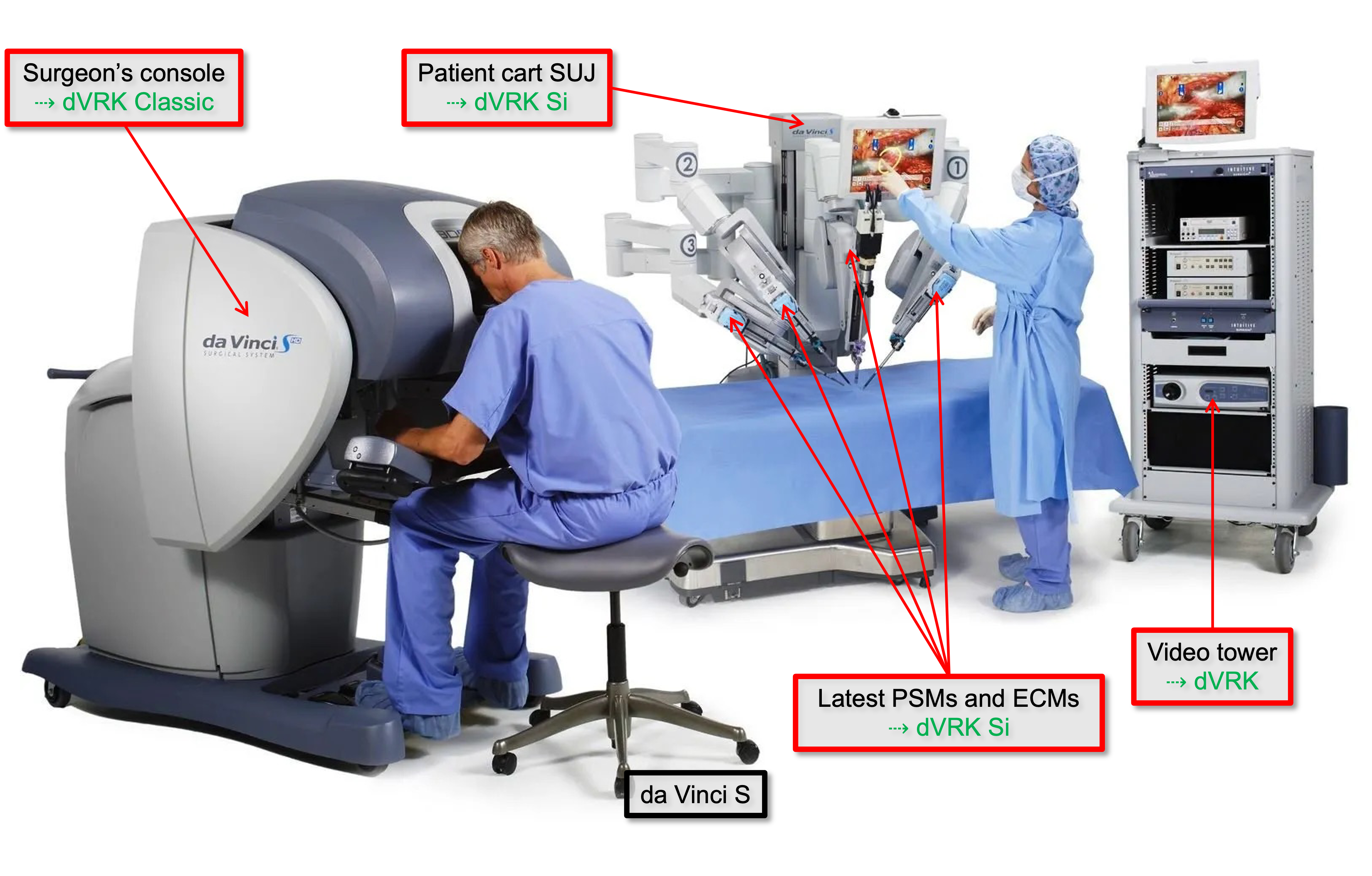
da Vinci S: surgeon’s console, patient’s cart and video tower
dVRK integration
The following components can be used for the dVRK (see dVRK setup)
Surgeon’s console (Classic and S)
MTMs: master tele manipulators, the two arms the operator uses to control the patient’s side, 7 dof haptic devices with gripper (passive)
Foot pedals: pedals used to switch the control modes while operating, select which PSM or ECM to use, clutch, focus…
HRSV: high resolution stereo viewer, aluminum frame with optics, mirrors and CRT monitors for both eyes
Head sensor: sensor used to detect if the operator is looking at the stereo display and enable the teleoperation
Console lift motor: adjustable height for the HRSV for better ergonomic
Console frame: can be reused to hold everything as opposed to building a custom frame
Video tower (Classic and S), see dVRK video support
Light source
Camera control units (SD and HD)
Focus controller
The rack itself if provided along the dVRK
Patient’s cart (Classic only)
SUJ: setup joints, cart with central column and up to 4 passive arms with brakes to position the active arms around the patient
PSMs: patient side manipulators, active arms holding the laparoscopic instruments with EndoWrist
ECM: endoscopic camera manipulator, active arm holding the stereo endoscope
The following components are not supported:
Surgeon’s console buttons on arm rest
Original video pipeline with icons, etc.
Audio between the surgeon’s console and the video tower